


In recent days, a video has been widely circulating on social media showing a person sliding down a section of an irrigation channel, being swept away by a strong current of water. The recording has sparked indignant comments, including from public figures such as geographer Raimundo Quintal, who has long warned against inappropriate behavior in sensitive natural areas.
At the same time, doubts arose about the authenticity of the video, as well as assumptions that it might be a montage or even content generated by artificial intelligence. Is the video real and was it filmed in Madeira?
The verification of the video’s authenticity and location was based on two complementary axes.
The first step consisted of a rigorous technical analysis of the video itself, supported by AI tools capable of identifying inconsistencies, visual artifacts, and morphological anomalies typically associated with artificially generated videos. The second step came from someone highly knowledgeable about the levadas (irrigation channels) of Madeira, who assessed the natural setting and confirmed the location, requesting anonymity.
Research was also conducted on similar content, specifically photos and videos of nature shared by individuals and companies involved in outdoor activities, over the past few years.
The technical analysis focused on evaluating several elements. Let’s look at them:
Water behavior
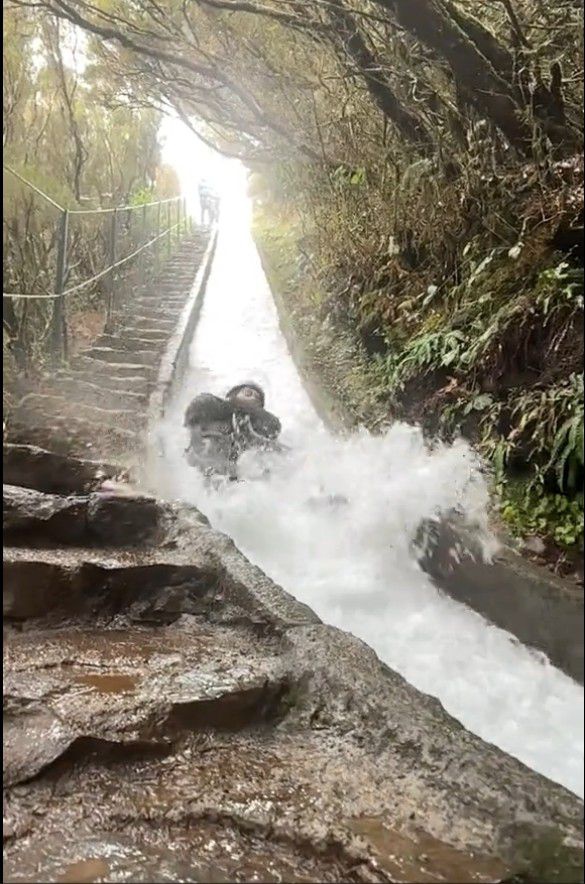
In the analyzed video: The flow exhibits continuous movement, without unexpected breaks or pattern repetitions; The formation of foam and splashes is highly complex, with natural variations in density and unpredictable directions; The impact of the water on the person’s body is physically coherent, including twists and small eddies that arise spontaneously.
These details are characteristic of real water. AI would have left traces of artificial smoothing, repeated patterns, or an absence of micro-movement, none of which are present in the analyzed video frames.
Vegetation and irrigation channel walls
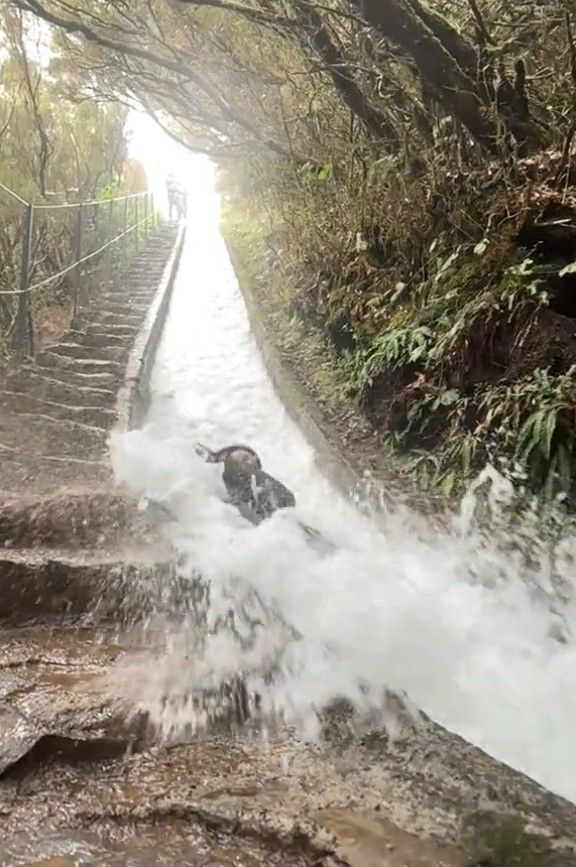
The sides of the irrigation channel, the texture of the stone, the moss, the wet and dry areas, and the surrounding vegetation exhibit natural irregularities that are not repeated between frames.
Artificially generated content often exhibits: repetitive vegetation patterns; leaves with gelatinous edges; non-physically ‘wavy’ areas; or inconsistent light reflection.
None of this is observable in the analyzed images. The vegetation behaves completely normally, including leaves partially blurred by camera movement, moss clinging to the walls, and the typical shine of damp surfaces. These details are difficult to synthesize artificially in a consistent manner over several seconds.
Human anatomy
The movement of a person sliding and falling exhibits: natural changes in posture; trunk rotations consistent with loss of balance; impact with the water that produces real deformations in the body; and continuity between frames without abnormal jumps.
Generative video models often create bodies with erratic proportions, deformed limbs in fast-forward frames, or sudden posture transitions. None of this occurs in the analyzed material. The human body maintains stable proportions and reacts physically to its surroundings.
Lighting and depth
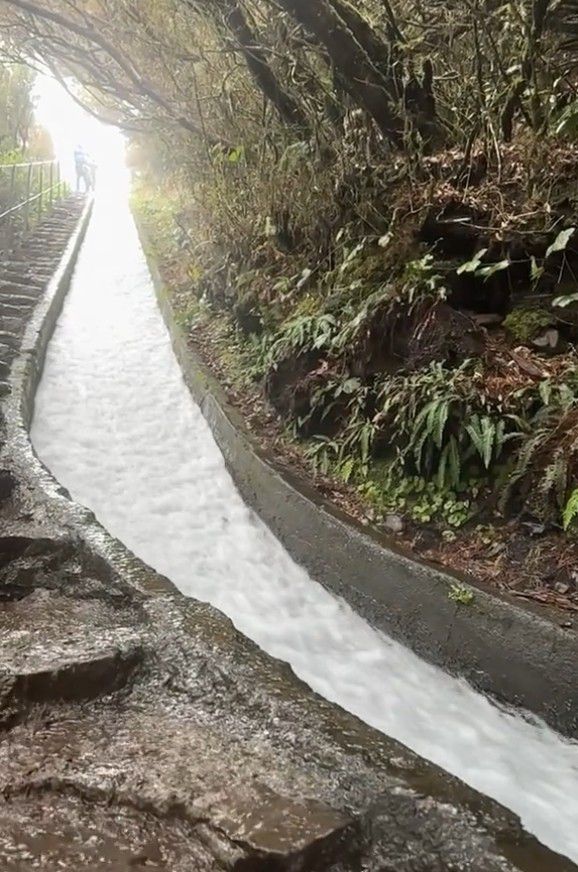
The natural light distributed throughout the irrigation channel is consistent with a humid and open valley. The brightness in the background and the shadows on the side walls appear coherently. The depth of field varies with the slight movement of the camera, which is typical of mobile phone recordings.
Artificial videos tend to exhibit: excessively uniform brightness; inconsistent shadows; backgrounds that blur without logic; or lighting that appears ‘painted’. None of these flaws were found.
Thus, the result of the technical analysis is that everything points to a real video, probably recorded with a mobile phone, with no signs of artificial editing.
Identification of the irrigation channel
The person consulted by DIÁRIO — with in-depth knowledge of Madeira’s levadas — analyzed the scenery, topography, slope, canal walls, water color, and surrounding vegetation. The conclusion is clear: the video was filmed on the Levada do Alecrim, in the Rabaçal area, in the municipality of Calheta.
This is a particularly recognizable stretch for those familiar with the area, with specific morphological characteristics and easily distinguishable from other levadas (irrigation channels). Moreover, our searches on social media point in exactly the same direction.
Video temporality
Despite its current widespread circulation, research indicates that the video may not be recent.
In March 2022, very similar videos and photographs, taken on the same stretch of the Levada do Alecrim, were released by individuals and nature tourism companies. Some of these images show people engaging in recreational descents under conditions identical to those in the video under analysis.
It’s impossible to say for sure that it’s exactly the same recording, but the spatial and behavioral similarities suggest that the now-viral video may be about three years old.
The recent controversy — fueled by Raimundo Quintal and other environmental preservation advocates — focuses primarily on the ecological consequences of these actions. This debate, while relevant, is not the subject of this fact-check, which is limited to verifying the authenticity and location of the video.
Based on the technical analysis, qualified evaluation, and contextual research, we conclude: The video is authentic. It was filmed in Madeira, at Levada do Alecrim, Rabaçal, Calheta.
It was likely registered about three years ago, with similar content dating back to March 2022.
For all these reasons, the claim that the video is real and filmed in Madeira is considered true.
